
How to Join Wood: Screws vs Glue vs Dowels (Which One Holds Best for Beginners?)
TL;DR
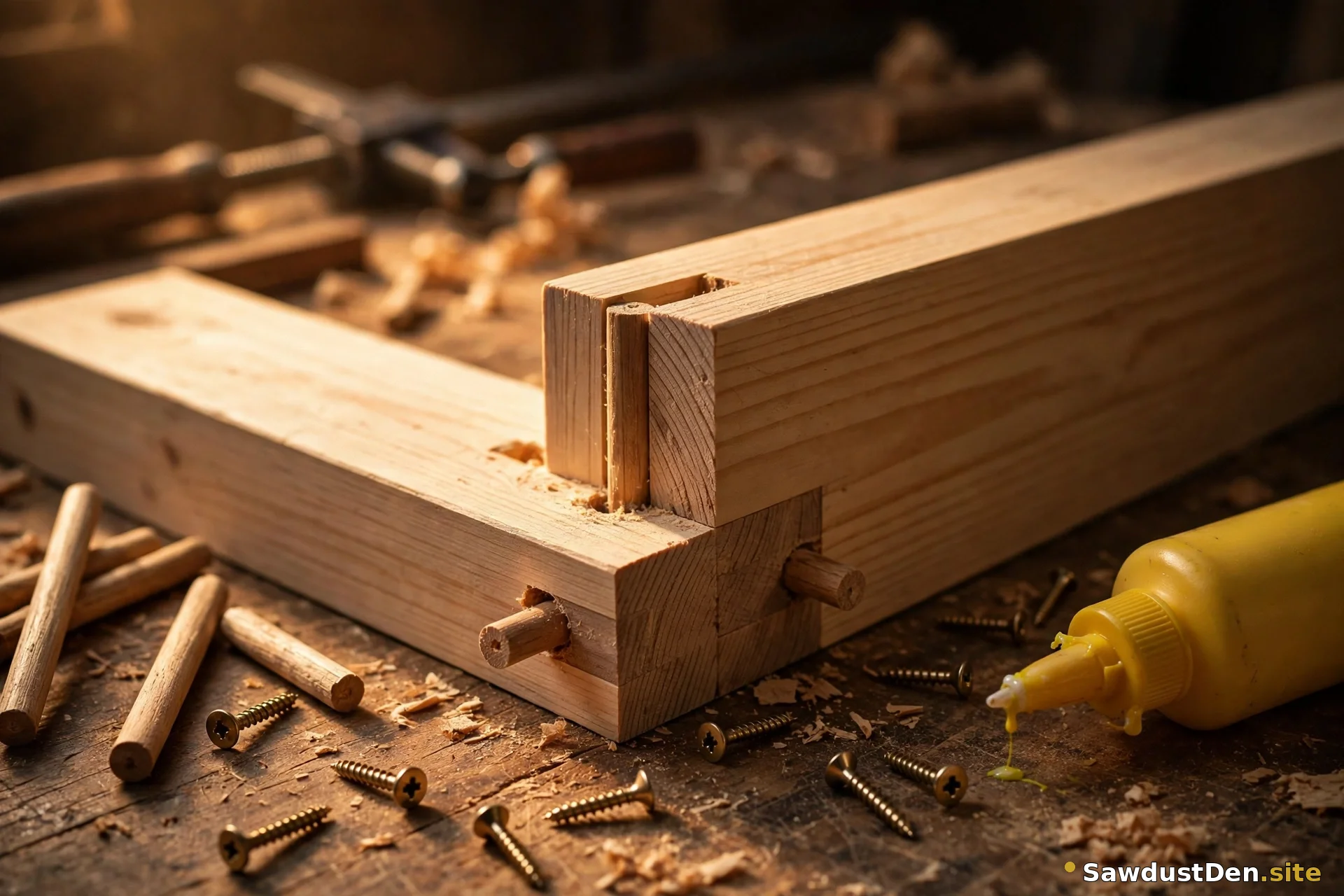
How to join wood comes down to three choices: screws for speed and strength, glue for invisible long-grain joints, and dowels for hidden alignment — and the right choice depends on the project, not on which method is strongest in general. Screws hold immediately and come apart later, glue holds invisibly but needs clamping time and only works well on long grain, and dowels hide the joint and help alignment but need accurate drilling. The table below picks the winner for each Day-1 project, so you never have to guess.
In this guide
- The three-way table
- Screws, in detail
- Glue, in detail
- Dowels, in detail
- Which joint for which project
- Fix it: loose, split, or misaligned joints
- Safety notes
- FAQ
The three-way table
- Screws: fast, strong, hold immediately, can be taken apart later. Downside: visible unless plugged or hidden, and they need pilot holes to avoid splitting. Tools needed: drill/driver, drill bit, driver bit. Wait time: none — the joint holds as soon as the screw is driven.
- Glue alone: invisible, very strong on long grain, cheap. Downside: weak on end grain, needs clamping until set, and cannot be taken apart. Tools needed: glue bottle, clamps. Wait time: hours to full cure, depending on the glue.
- Dowels: hidden, strong, help align parts precisely. Downside: needs accurate drilling, and a misaligned dowel locks the error in place. Tools needed: drill, dowel centres or a simple jig, clamps. Wait time: glue cure time, like glue alone.
No method wins on every row. Screws win on speed and reversibility, glue wins on invisibility and cost, dowels win on hidden strength and alignment. Pick by what the project needs, not by habit.
Screws, in detail
Screws are the beginner’s best friend for a reason: they hold immediately, they pull parts tight as they drive, and if you get it wrong, you can back them out and try again. That reversibility is worth a lot on a first project.
Two rules make screws work. First, drill pilot holes, especially near board ends and in hardwoods. The pilot hole should be slightly smaller than the screw’s core (the solid shaft under the threads, not the thread diameter) — big enough to prevent splitting, small enough that the threads still bite and hold. Second, match the screw length to the stock: for joining 3/4-inch board to 3/4-inch board, 1-1/4-inch screws are the standard choice, long enough to bite well without poking through the other side. Our shelf guide uses exactly that size for its brackets and cleat.
Screws show, unless you hide them. Countersink the head slightly below the surface and fill it, plug the hole with a wooden plug, or place screws where they will not be seen — under a shelf, on the back of a frame, inside a cabinet. If the look matters and screws would show on the face, consider glue or dowels for that joint instead.
Glue, in detail
Wood glue is stronger than most beginners expect — a well-glued long-grain joint is often stronger than the wood around it, because the glue bonds fibres across a large surface. That is why a cutting-board panel, glued edge to edge, holds for years with no screws at all.
Glue has two limits you must respect. First, it is weak on end grain, which soaks glue up like a sponge and leaves a starved, weak joint. Never rely on end-grain glue alone for a structural joint; use screws, dowels, or a different joint design instead. Second, glue needs clamping until it sets. A joint glued but not clamped will shift, gap, or spring open as it dries, and no amount of extra glue fixes a joint that moved during curing.
Apply a thin, even coat — not a puddle. Too much glue squeezes out everywhere and makes a mess that blocks stain later. Too little starves the joint. A thin, continuous film on one face of the joint, clamped firmly until set, is the goal. Wipe squeeze-out off both faces right away with a damp cloth, before it dries, because dried glue shows as pale patches under stain, as our stain guide explains.
Dowels, in detail
Dowels are short wooden pins glued into matching holes in both parts. They hide completely inside the joint, they add real strength, and they align parts precisely — which is why they are popular for frames and furniture where screws would show.
For 3/4-inch boards, 3/8-inch dowels are the common beginner choice: roughly half the board thickness, thick enough to hold, thin enough not to weaken the board. Drill each hole slightly deeper than half the dowel length, so the dowel seats fully without bottoming out and pushing the joint apart. Use fluted dowels — the grooves let glue and trapped air escape, so the dowel seats fully instead of hydraulic-locking halfway in.
Accuracy is everything with dowels. Mark both parts together, drill straight, and always dry-fit before any glue touches wood: assemble the joint with dry dowels, check alignment and squareness, and only then take it apart, glue, and reassemble. A misaligned dowel joint glued in place is very hard to fix, while a dry-fit mistake costs nothing but a re-mark.
A simple dowel jig or a pair of dowel centres (small metal points that mark the matching hole position) makes accurate drilling much easier for a beginner, and both cost little. Freehand dowel drilling without a guide is how most dowel joints end up misaligned.
Which joint for which project
- Wall shelf cleat: screws into studs. The cleat carries weight into the wall framing, and only screws do that job. See our shelf guide for the full cleat method.
- Shelf frame: screws plus glue. Screws hold immediately and pull the frame square, glue adds long-term strength across the long-grain joints. Together they beat either method alone.
- Cutting-board panel: glue only. Edge-to-edge long-grain glue gives an invisible, food-safe panel with no metal in the board. See our cutting board project for the glue-up method.
- Plant-stand frame: screws plus glue, or dowels for a cleaner look. Screws and glue are fastest and strongest for a first stand; dowels give the same frame a furniture look with no visible fasteners, once your drilling is accurate.
If your project is not listed, ask two questions: does it need to come apart later (screws win), and will the joint be visible (glue or dowels win for faces, screws win for hidden backs and undersides).
Fix it: loose, split, or misaligned joints
Stripped screw hole: the screw spins without biting because the wood around it is chewed out. Fix it by filling the hole with a glued dowel — glue a dowel into the hole, let it cure, trim it flush, then re-drill a pilot hole and drive the screw again. The new wood gives the threads something fresh to bite.
Misaligned dowels: the parts do not line up in dry-fit. Do not force them and do not glue yet. Re-mark from the correctly aligned position, re-drill, and dry-fit again. If a hole is already drilled wrong, plug it with a glued dowel, let it cure, and re-drill in the right place.
Glue-starved joint: the joint feels weak or gaps after curing, usually from too little glue or from clamping that squeezed all the glue out. Take it apart if you can, apply a thin even coat, clamp firmly but not so hard that all glue squeezes out, and let it cure fully. If the joint cannot be taken apart, screws can reinforce it from a hidden side.
Split joint: the wood cracked, usually from a screw driven without a pilot hole, or too close to the board end. Prevent it next time with pilot holes and by keeping screws at least a few diameters from board ends. Fix a split by gluing the crack, clamping it closed, and letting it cure, then re-drilling with a pilot hole before re-driving the screw.
Safety notes
Clamp the work before any drilling, keep hands clear of the drill exit side (the bit exits with force and can catch skin), and wear safety glasses for all drilling and sawing. Wipe glue squeeze-out before finishing, as above, because dried glue blocks stain and shows under clear finishes. Let glued joints cure fully before stressing them — a half-cured joint flexed early never regains full strength.
FAQ
Are screws or glue stronger?
On long grain, a well-glued joint is often stronger than the wood itself, while screws are strong but concentrate force at points. On end grain, screws win easily, because glue alone is weak there. The honest answer is that stronger depends on the grain direction and the load — which is why many joints use both, screws for immediate hold and glue for long-term strength.
Do I need glue if I use screws?
Not always, but often yes. Screws alone hold well for a shelf cleat into studs. For frames and panels, glue adds strength across the whole joint, seals gaps, and stops squeaks and movement over time. If the joint will be visible and you want it to last, use both unless there is a reason not to.
What size dowel for 3/4-inch boards?
3/8-inch dowels are the standard beginner choice for 3/4-inch stock — about half the board thickness. Drill holes slightly deeper than half the dowel length, use fluted dowels, and always dry-fit before gluing. Thinner dowels are too weak, thicker dowels weaken the board around the hole.
Why did my joint split?
Usually a screw driven without a pilot hole, or too close to the board end, or over-tightened until the wood cracked. Drill pilot holes slightly smaller than the screw core, keep screws away from ends, and set your drill clutch low so screws stop before they over-drive. A split already happened can be glued and clamped, as above.
Can I take a screwed joint apart later?
Yes — that is one of screws’ biggest advantages over glue and dowels. Back the screws out, and the parts separate, usually undamaged if pilot holes were used. Glued and doweled joints are effectively permanent; taking them apart usually breaks wood. Choose screws when you might need to disassemble, move, or repair the piece later.
If a joint choice for your project still is not clear, send a message through the Contact page and we will help you sort it out.