Pine vs Oak vs Plywood: Which Wood Should Beginners Actually Buy First?
TL;DR
Pine vs oak vs plywood — the short answer: buy pine for practice and painted projects, plywood for wide flat panels, and oak when you want a stained hardwood look and are ready to pay more and work a little slower. Pine is cheapest and softest, oak is hardest and strongest, plywood is flattest and most stable. None of the three is “best” in general — each one wins for a different first project, and the table below tells you which one wins for yours.
In this guide
- The decision table
- Pine, in detail
- Oak, in detail
- Plywood, in detail
- First-project picker
- How to pick straight boards at the store
- How each one finishes
- FAQ
The decision table
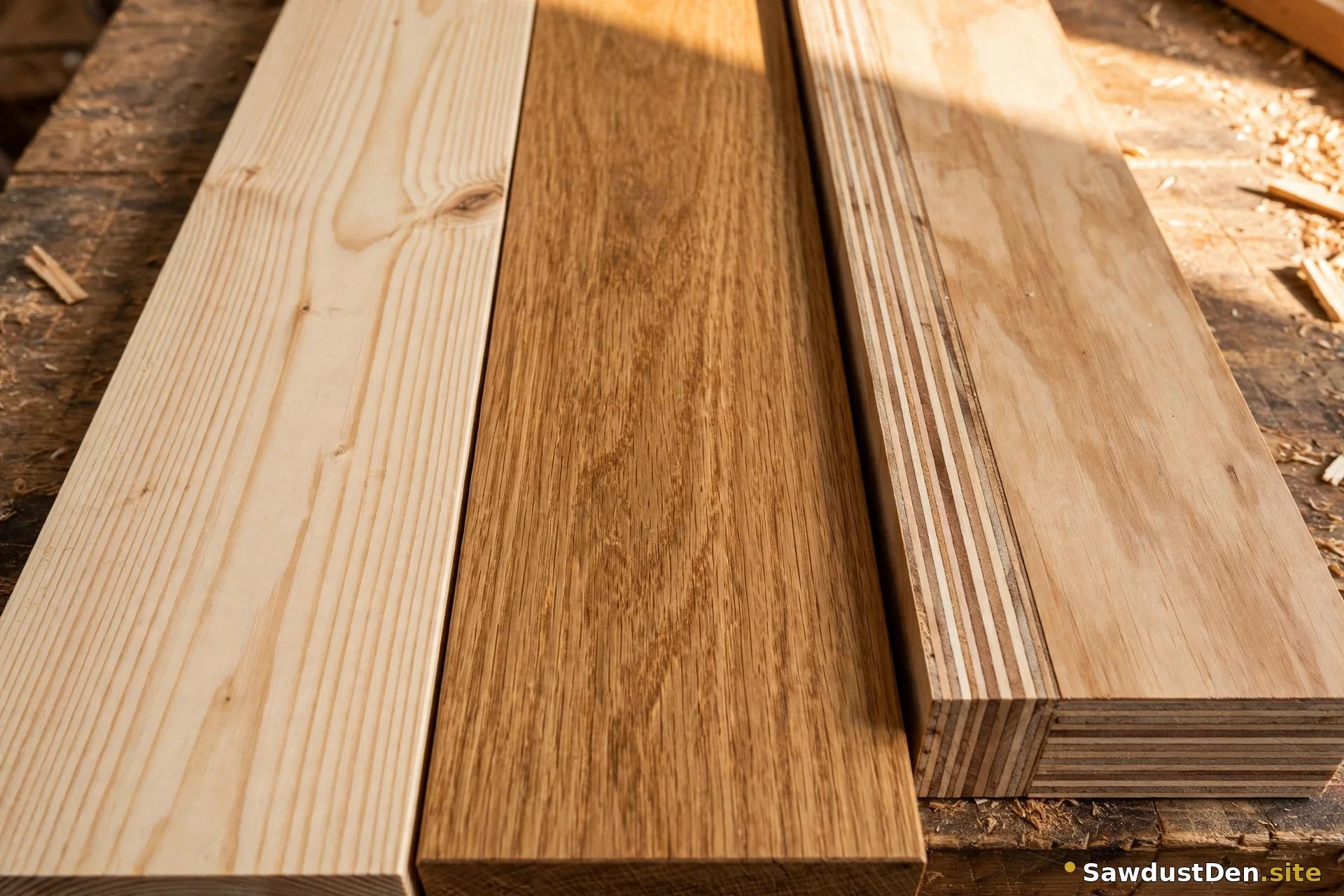
- Pine: cheapest, softest, dents easily, paints well, stains unevenly. Buy this when you are practising, painting, or building your first shelf or plant stand on a budget.
- Oak: hard, strong, bold open grain, stains beautifully, heavier and pricier, harder on beginner tools and slower to cut and sand. Buy this when you want a stained hardwood look that lasts.
- Plywood: stable, flat, best for wide panels, does not warp like solid boards, but the layered edges look unfinished and need banding or trim. Buy this when you need a wide, flat, stable panel, like a shelf span or a cabinet side.
Read the table, find your project in the picker below, and you have your answer. The detail sections explain why each row says what it says, so you can adjust when your next project is different.
Pine, in detail
Pine is the wood most beginners start with, and for good reasons. It is widely available, easy to cut and sand, light to carry, and forgiving when you make a mistake — a miscut pine board costs little to replace. It takes screws well with pilot holes, glues cleanly, and paints beautifully, because paint hides the soft grain and the knots.
Its weaknesses are the flip side of its softness. Pine dents under a dropped tool, a heavy book corner, or even a firm fingernail. Dents do not affect strength, but they show, especially under a clear finish. Pine also stains unevenly: the soft earlywood soaks up stain darker than the hard latewood, leaving a blotchy look that surprises every beginner. That is not a defect in your technique — it is how pine behaves — and the fix is a pre-stain conditioner or a gel stain, covered in our stain guide.
Buy pine when: you are learning, you plan to paint, you are building a first shelf, a plant stand, or a practice project, or your budget is tight. Do not buy pine when: the piece will take hard daily wear unpainted, or you want a rich stained hardwood look — pine will not give you that, no matter how careful your finish is.
Oak, in detail
Oak is a true hardwood, and it feels like one the moment you pick it up. It is heavy, hard, and strong, with a bold, open grain that looks unmistakably like wood. It stains beautifully — the grain takes colour evenly and shows through the finish — and a well-finished oak piece lasts for decades. For a stained furniture look, oak is the honest choice among these three.
That quality costs you in three ways. Oak costs more than pine, sometimes several times more for the same size board. It is heavier to carry and harder to cut, drill, and sand, which means slower work and duller blades if your tools are basic. And its open grain needs filling or extra finish coats if you want a glass-smooth surface; otherwise the grain texture shows through, which some people love and some do not.
Buy oak when: you want a stained hardwood piece you will keep, you are ready to work slower, and your budget allows it. Do not buy oak when: you are still learning basic cuts and joints — practise those in pine first, then spend oak money on a project you already know how to build.
Plywood, in detail
Plywood is not a species, it is a sheet: thin layers of wood glued with the grain alternating, which makes it remarkably stable. A plywood panel stays flat where a solid board might cup or warp, and it comes in wide sheets, so it is the best choice for wide panels — shelves, cabinet sides, tabletops — without gluing up strips.
Its weakness is the edge. Cut plywood shows its layers, which look unfinished and soak up finish unevenly. The fix is edge treatment: iron-on edge banding for a clean look, or a solid wood strip (often called nosing) glued to the edge for a furniture look. Both are beginner-friendly, and both are covered in the finish section below.
One practical note: plywood thickness is nominal, like solid boards. A sheet labelled 3/4 inch is often slightly under that in reality, so measure the actual sheet before you cut joints that depend on its thickness, like dados or rabbets. For screws and butt joints, the small difference does not matter.
Buy plywood when: you need a wide, flat, stable panel, you are building shelves or storage, or you want oak-veneer plywood for a stained look without solid-oak cost. Do not buy plywood when: you want solid-wood edges on display without treating them, or you need thick solid stock for carving or turning.
First-project picker
- Shelf: pine or plywood. A solid pine board works for a single shelf, and plywood works for wider spans. See our shelf guide (https://sawdustden.site/build-a-wooden-shelf/) for the full cut list.
- Cutting board: neither. A food board needs a food-safe hardwood like maple, walnut, or cherry — pine is too soft and dents, plywood edges and glue lines are wrong for food contact. See our cutting board project (https://sawdustden.site/cutting-board-project/) for the full build.
- Plant stand: pine or poplar. Pine is cheapest and paints well; poplar is a step up in hardness and paints even smoother, if your store stocks it.
- Stained furniture look: oak, or oak-veneer plywood for wide panels. Solid oak for frames and legs, oak plywood for large flat parts, with solid edge trim to hide the layers.
If your project is not on this list, match it to the closest one: painted and practising means pine, wide and flat means plywood, stained and lasting means oak.
How to pick straight boards at the store
Bad boards ruin good projects, so check every board before you buy it, even if you are in a hurry.
Sight down every board from one end, like looking down a rifle barrel. A straight board looks straight. Reject boards that twist (one corner lifts when the board lies flat), bow (curve along the length), cup (curve across the width), or have loose or cracked knots that could fall out. Small tight knots are fine and add character; loose knots are weak spots.
Check the actual thickness with your tape measure, especially for plywood, which often runs slightly under its label. Check the width too: a 1×12 solid board actually measures 3/4 inch thick by 11-1/4 inches wide, as our shelf guide explains. And buy one spare board for mistakes. Beginners miscut, and a spare board at store prices beats a second trip mid-project every time.
Bring your tape measure and speed square from the beginner kit — our tools guide (https://sawdustden.site/beginner-woodworking-tools/) explains both — and measure in the store, not just at home.
How each one finishes
Pine and paint are best friends: prime, paint, and pine looks smooth and clean. Pine and stain need help: use a pre-stain conditioner, test on an offcut, or use a gel stain that sits on the surface instead of soaking unevenly. Without one of those, expect blotches.
Oak and stain are best friends: stain evenly, let the grain show, and finish with a clear topcoat. If you want a smooth surface, fill the open grain first or accept the grain texture as part of the look. Oak paints fine too, but painting over oak’s beautiful grain wastes what you paid for.
Plywood finishes depend on its face. Paint-grade plywood paints well. Oak-veneer plywood stains like oak on its faces, but the edges need banding or solid trim first, or the layers will show and soak up stain dark. Iron-on banding, applied with a household iron and trimmed flush, is the simplest edge fix for a first project.
For the full stain method, including the pre-stain step most beginners skip and the oily-rag safety rule, see our stain guide (coming next in this series).
FAQ
Is pine too soft for furniture?
For painted furniture, practice pieces, and light-use items like shelves and plant stands, no — pine is fine and widely used. For a hard-wearing unpainted surface, like a dining table or a workbench top, yes — pine will dent and show wear faster than oak or hardwood plywood. Match the wood to the wear, not to an idea of “real” furniture.
Can I stain plywood?
Yes, on its faces, especially oak-veneer plywood, which stains like solid oak. Treat the edges first with banding or solid trim, or the layers will soak up stain unevenly and look striped. Test your stain on an offcut of the same sheet before committing to the whole panel.
Why is my pine board warped?
Pine moves with moisture, and boards stored flat against a damp surface, or dried unevenly with one face exposed, will cup, bow, or twist. Store boards flat, stickered (with small spacers between them) so air reaches both faces, and buy straight boards using the sight-down check above. A slightly warped board can sometimes be flattened by careful jointing and sanding, but a badly twisted board is better replaced than fought.
Is oak too hard for a beginner?
Not too hard to use, just slower and pricier. If you already know the basic cuts and joints from pine practice, oak is a fine next step — just expect slower cutting, more sanding, and sharper blades. If you are still learning, practise in pine first and save oak for a project you know how to build.
What thickness should I buy for shelves?
For shelves up to 36 inches long, 3/4-inch material — solid pine or plywood — works well with brackets and a cleat, as our shelf guide shows. For longer spans, add a centre support so no section spans more than 36 inches unsupported, or step up to thicker stock. Measure actual thickness before cutting joints that depend on it.
If a wood choice for your project still is not clear, or your store stocks something this guide does not cover, send a message through the Contact page (https://sawdustden.site/contact/) and we will help you sort it out.